
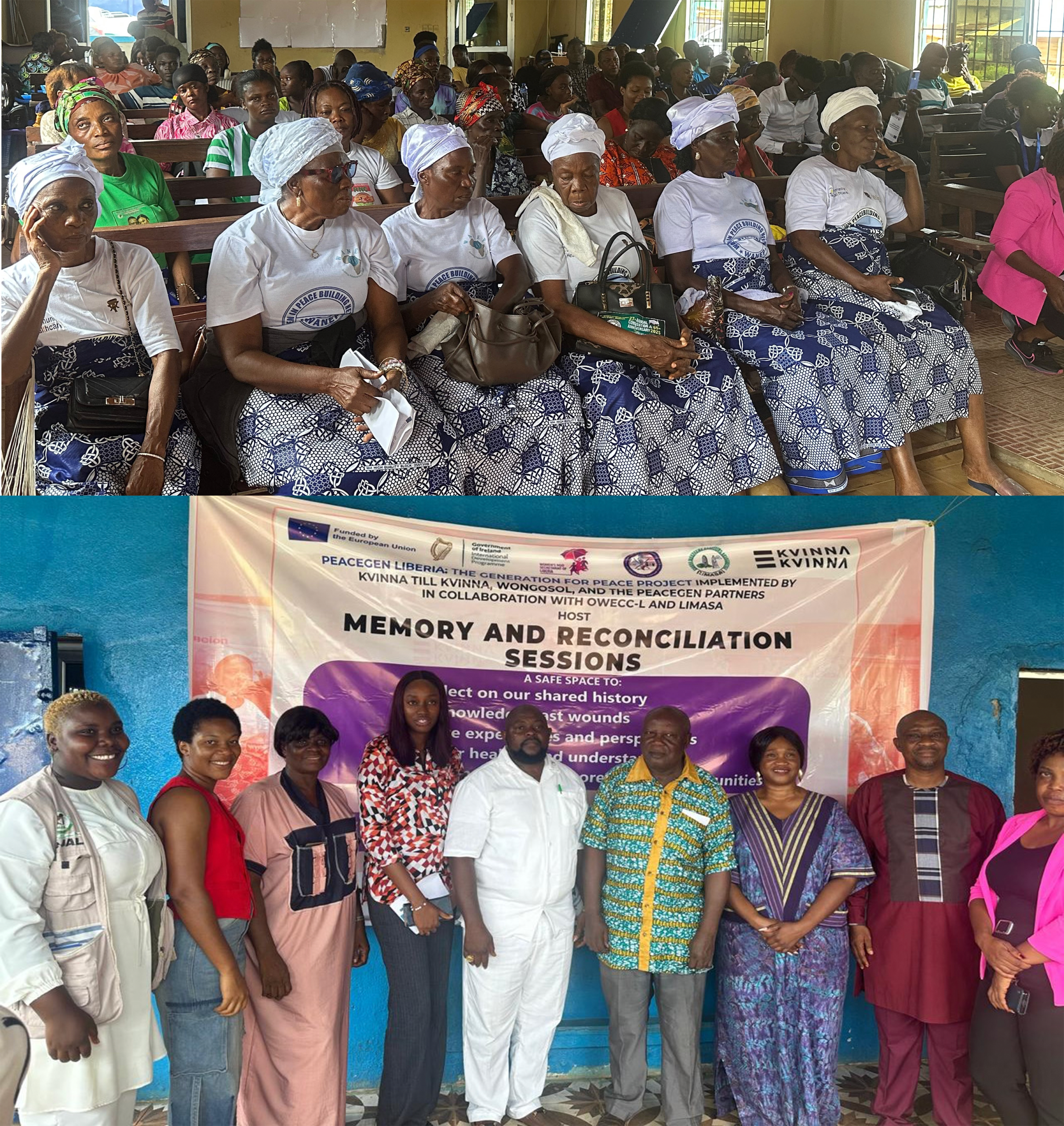
For 23 years, the scars of Liberia’s civil wars have remained buried beneath a fragile peace. But on August 18, 2026, in Montserrado, something shifted. Survivors, young people, and community leaders gathered not for speeches or ceremonies, but for something far more profound a chance to finally break the silence.
The Generation for Peace Project, funded by the European Union and co-funded by the Embassy of Ireland, is a three years project implemented by Kvinna till Kvinna, WONGOSOL, and PeaceGen partners in collaboration with OWECC-L and LIMASA, hosted a Memory and Reconciliation Session to commemorate the 23rd anniversary of the signing of the Accra Comprehensive Peace Agreement. For many attendees, this was not just another event. It was a lifeline.
The atmosphere was unlike any other. Guided by survivor-centered and trauma-sensitive principles, participants were invited to share their personal stories of Liberia’s turbulent past. The room hummed with quiet courage as one by one, voices emerged from the shadows of memory. The goal was clear: to ensure that the pain of the past was acknowledged, not exploited, and that every person felt safe enough to speak their truth.
What made this session truly remarkable was its deliberate intergenerational nature. Older generations, who had lived through the horrors of the civil wars, sat side by side with young Liberians who have only known peace. The elders spoke of loss, displacement, and survival. The youth listened not as passive observers, but as active participants carrying their own hopes and ideas for the future. Together, they began building a vital bridge between remembering and rebuilding.
The conversations flowed from personal testimony to national accountability. Themes of truth, justice, and the urgent need for reparations emerged issues that still simmer beneath the surface of Liberia’s fragile peace. It was a reminder that healing is not a destination but a continuous, collective act of courage.
FeJAL provided multimedia support, documenting the session through photography and video coverage. Every key moment, every speaker, and every intergenerational discussion was captured, contributing to the visibility and preservation of the PeaceGen Liberia project and its peacebuilding efforts.
The event’s message was carried by powerful voices committed to the long road ahead. Madam Esther S. Davis Yango, Executive Director of the Women NGOs Secretariat of Liberia (WONGOSOL), reminded the audience that “peace” is more than a quiet ceasefire. She framed the session as a crucial step in a broader journey. “This isn’t just about the absence of war,” she stated. “It’s about truth, justice, and accountability. It means ensuring that women, young people, survivors, persons with disabilities, and marginalized groups are not just heard, but are central to the conversation.”
She emphasized that the careful, sensitive approach taken during the session where participation was voluntary and consent was always prioritized was essential for upholding the dignity of those who have already endured so much.
Adding to the gravity of the occasion, Sheikh S. S. Kamara, Executive Director of the Liberia Peacebuilding Office, delivered a keynote that challenged the audience to move beyond sentiment. He asked them to confront three hard-hitting questions: What do we remember? What have we truly reconciled? And what must we do next?
Before diving into his address, Kamara called for a moment of silence, honoring the countless victims of Liberia’s civil wars. He also paid tribute to the resilient women of the Women in Peacebuilding Network (WIPNET), whose courageous protests in 2003 helped pressure warring factions to lay down their arms. Yet, he did not shy away from the unfinished business of peace. He pointed out that many of the Truth and Reconciliation Commission’s (TRC) recommendations remain unfulfilled, and that the economic and social benefits of peace have often failed to reach the country’s youth and rural communities.
His words seemed to echo a sobering truth: “The peace is fragile because the reconciliation is incomplete.”
For the participants who gathered there, the Memory and Reconciliation Session in Montserrado was not an ending but a beginning. It marked the start of a larger effort, with similar gatherings planned for Bong County on August 21 and Bomi County on August 25.
As Liberia moves further away from its dark past, these sessions serve as a vital reminder that healing is not a destination it is a continuous, collective act of courage. Through shared stories and shared silence, Liberians are learning that the path to lasting peace begins not with forgetting, but with finally breaking the silence together.